The town nobody rebuilt: Kernavė
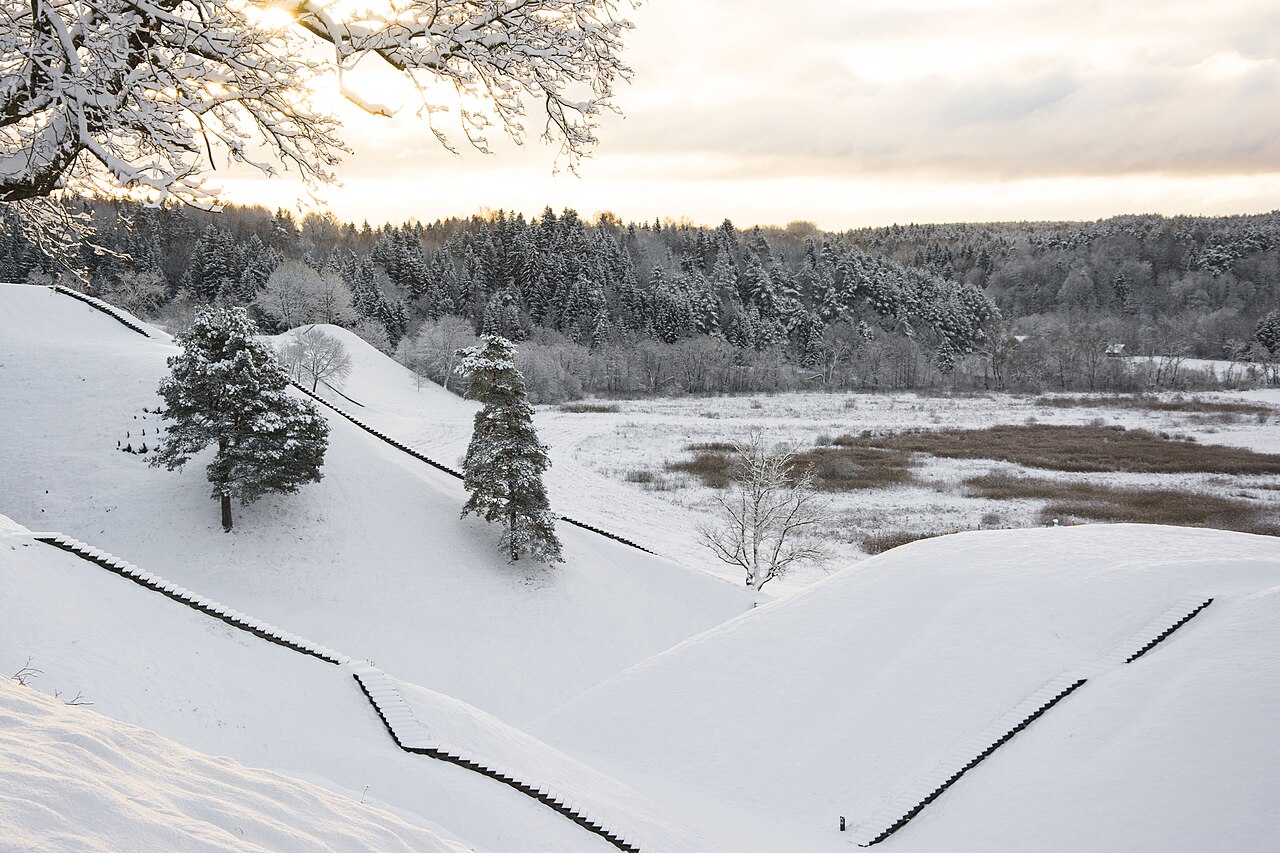
In 1390 the Teutonic Knights burned the town in the Pajauta valley and its people moved up the hill. Nobody built it back — and that is why it is still there.
Kernavė stands on the right bank of the Neris, thirty-five kilometres north-west of Vilnius: five hillforts in a row above a wide valley. In the 13th century this was the first capital of Lithuania — a seat of the grand dukes and the mark of a state that was still pagan. Written sources name it in 1279, when the Teutonic Knights besieged the residence of Grand Duke Traidenis.
The valley that closed over the town
In 1390, during the civil war, the knights burned the town in the Pajauta valley together with its castle. The survivors moved up onto the hill, and the valley was left alone. Over the centuries the river laid down silt and the ground turned to wet peat.
Peat keeps out air, and without air almost nothing rots. Wood, leather, textile, the layout of the streets — everything stayed where it fell. Archaeologists call Kernavė the Troy of Lithuania, and the comparison is not about the drama but about the depth: the layers of a whole town, sealed and never built over.
What drew us to this place
That a disaster turned into a method of preservation. A town rebuilt six times would have told us far less. Among the finds is a medgrinda — a timber road laid under water between the fourth and the seventh centuries, so that whoever knew the way could cross and whoever did not could not. Excavations have run here every year since 1979 and are still not finished.
Where to see it
Kernavės archeologinės vietovės muziejus — Kerniaus g. 4A, Kernavė. Three halls cover the site itself, prehistory and the 13th–14th centuries; the hillforts are outside, freely accessible, a few minutes' walk away. The reserve has been state-protected since 1989, and in 2004 the site entered the UNESCO World Heritage list.
On the last Sunday of every month the permanent exposition is free.
Where to see it in person: Kernavės archeologinės vietovės muziejus · Kernavė