Sonata of the Stars: a painting composed like music
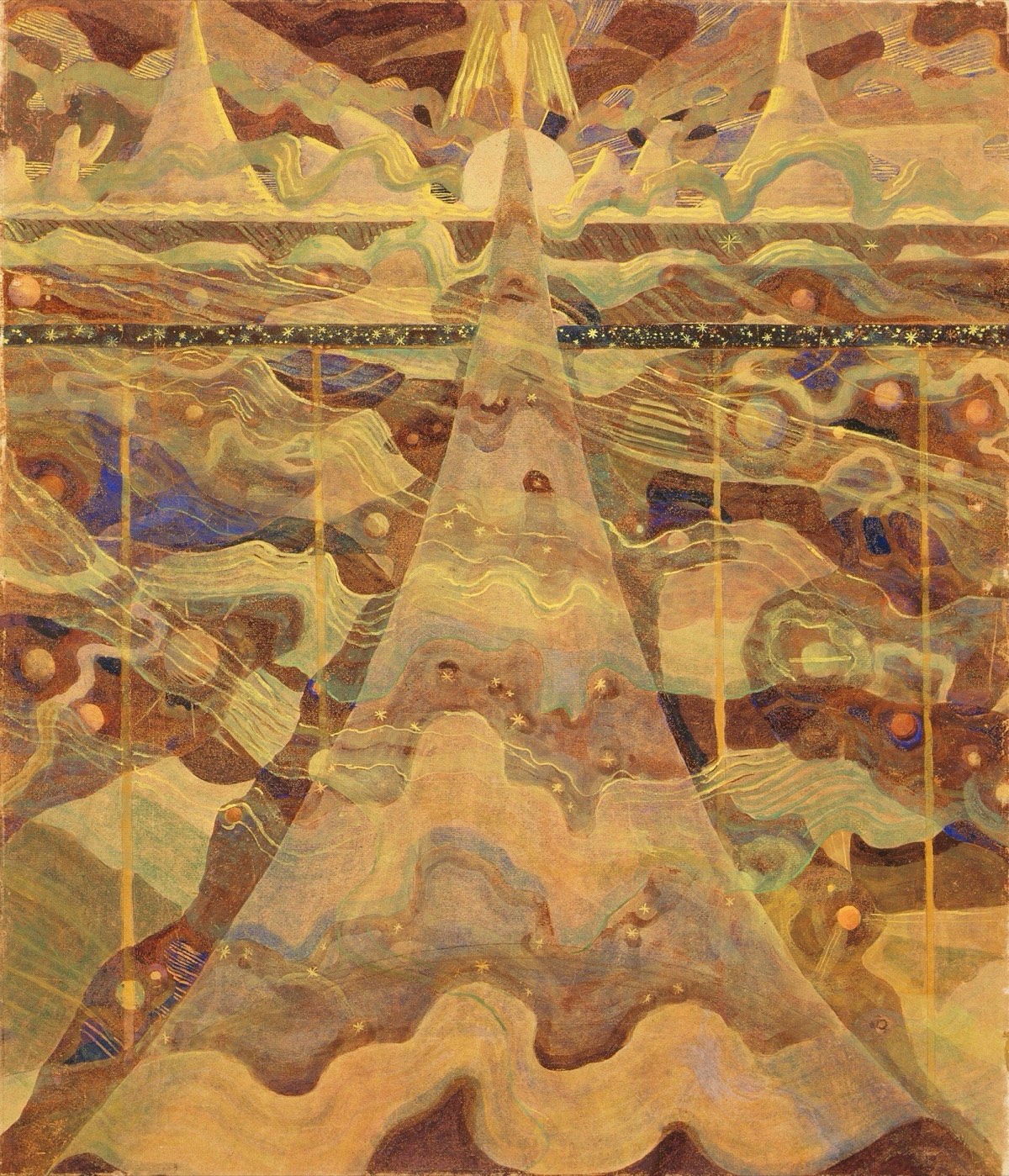
Kaunas keeps a painting with a musical tempo in its title: Allegro. Čiurlionis made it the way a composer would — not a scene, but a movement.
By 1908, Mikalojus Konstantinas Čiurlionis had written hundreds of musical pieces — and painted some three hundred works. Turn-of-the-century Europe was hunting for a new language of art; Čiurlionis found his where music meets painting.
A sonata you look at
He named a whole cycle of paintings sonatas — seven painted sonatas in all: of the Sun, Spring, the Serpent, Summer, the Sea, the Stars, the Pyramids. Each is built on the logic of musical form: tempo movements, a theme and its variations, a culmination.
Sonata VI, known as the Sonata of the Stars, was painted in 1908 in tempera on paper. It has two movements: a rushing Allegro and a quiet Andante — this sonata has no finale.
The Allegro opens a cosmic space with no ordinary perspective: glowing paths bend the void, and where they cross stands the silhouette of an angel. Planes overlap like voices in polyphony, diagonals set the tempo — you don't so much view this painting as read it, like a score.
Did Čiurlionis literally "hear" colours? Scholars still argue about synaesthesia — but his paintings are unmistakably built on musical principles: intervals, rhythm, recurring motifs.
1908 was one of the most intense years of his life: St Petersburg, recognition in artistic circles, his love for Sofija Kymantaitė. Three years later he was gone — Čiurlionis died in 1911, aged just 35.
Where to see it
The core collection of Čiurlionis' work is held at the M. K. Čiurlionis National Museum of Art in Kaunas. Works on paper are light-sensitive, so the display rotates — worth a quick look at the museum's site before you go.
And on the last Sunday of every month, the permanent exposition is free.
Where to see it in person: M. K. Čiurlionis Art Museum (main building) · Kaunas