The Girl with Verbos: a small canvas that became Lithuania's postcard from the 1840s
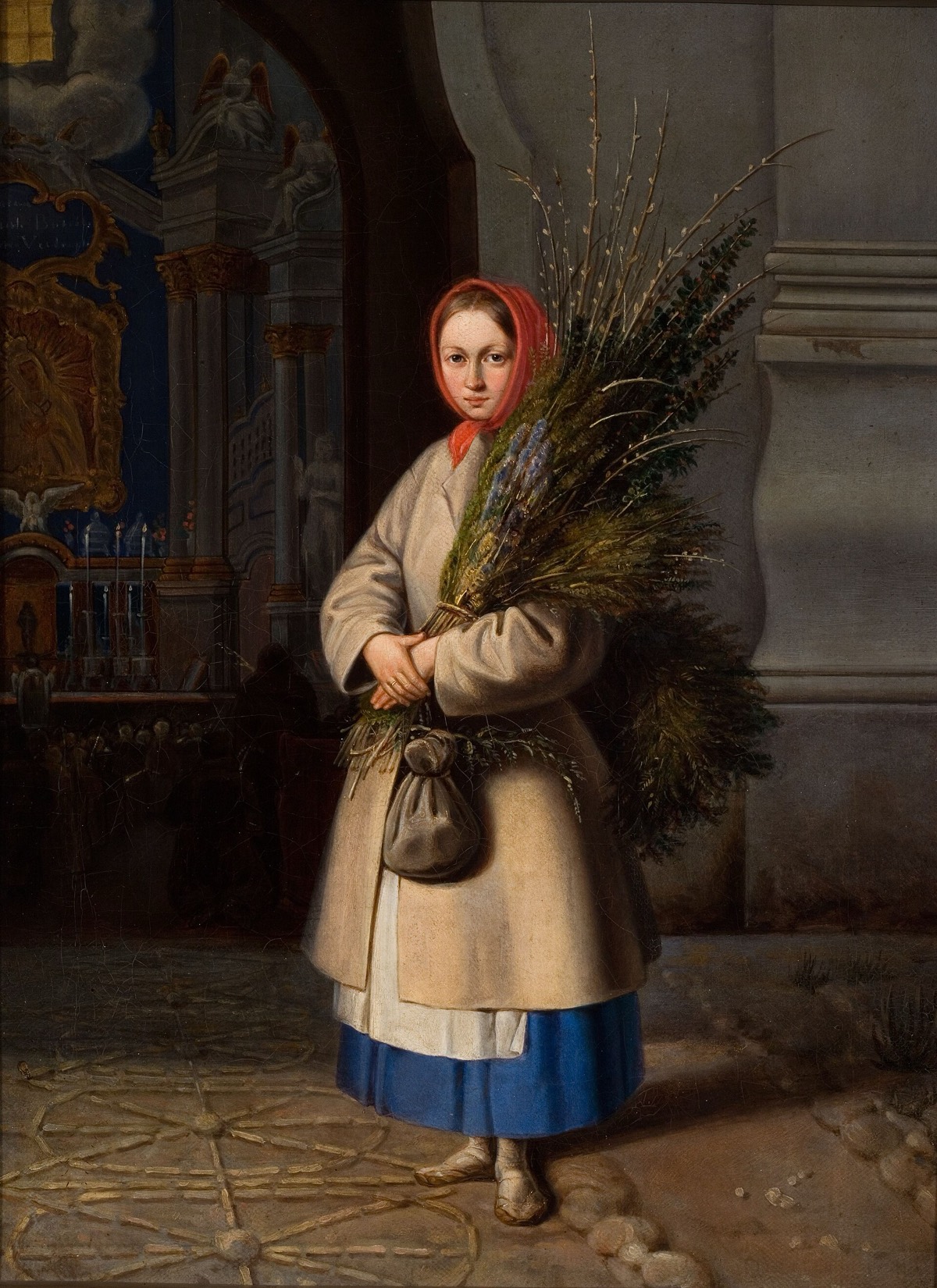
A small canvas — just 45 by 34 centimetres — holding an entire Vilnius spring: a girl, a bundle of verbos, and the light of Palm Sunday.
Kanutas Ruseckas studied in Vilnius, Paris and Rome — and came home with the eye of the Italian Romantics. Only the heroes of his paintings were not the gods of antiquity but ordinary people of Lithuania: reapers, peasant women, townsfolk.
The girl with the verbos
Ruseckas painted the Lithuanian Girl in 1847 in Vilnius, by the Church of St Mary the Comforter on Savičiaus street. A young woman in light dress carries verbos — the famous Vilnius palm bouquets, woven to this day only here and nowhere else in the world.
The composition is as simple as an icon: a figure in profile, a soft silhouette, a calm step. The Romantic age idealised the common folk — and Ruseckas painted his Lithuanian girl almost like a saint, with a bundle of spring verbos in place of a halo.
What drew us to this painting
In the mid-19th century, when Lithuania's name was being erased from the maps, an image like this was a quiet statement: here are our people, our customs, our feasts. Over time the painting became one of the most recognisable works of Lithuanian art — you'll find it in textbooks, on postcards and posters.
The most striking thing is that the painting is still alive: every Palm Sunday the same scene repeats in the streets of Vilnius — people carrying verbos. The canvas is nearly two hundred years old, and it is still about us.
Where to see it
The original hangs in the Vilnius Picture Gallery (Chodkevičiai Palace, Didžioji g. 4) — a branch of the Lithuanian National Museum of Art, among other works of 19th-century Vilnius art.
And on the last Sunday of every month, the permanent exposition is free.
Where to see it in person: Vilnius Picture Gallery · Vilnius