The iron wolf and the tricolour: what Gediminas' Tower keeps
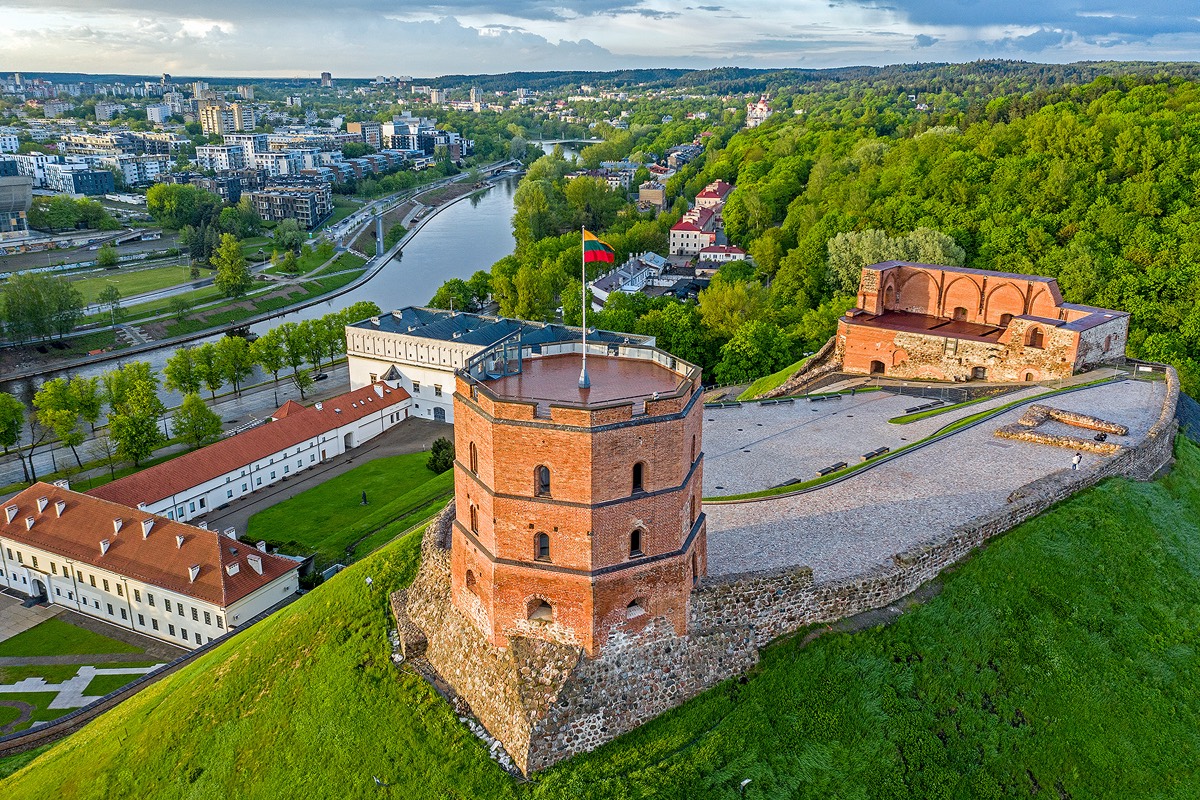
On the hill above Vilnius stands the only surviving tower of the Upper Castle. It holds two starting points of the city: the legend of the iron wolf, and the day the tricolour first flew over Lithuania.
Everyone knows the tale: Grand Duke Gediminas, hunting in the sacred woods, dreamt of an iron wolf howling with a hundred voices. The pagan priest Lizdeika read the dream — a capital would stand here, and its fame would carry across the world. By the early 14th century, Gediminas' letters already name Vilnius as his capital.
The tower
The brick Upper Castle on the hill took shape through the 14th–15th centuries; little of it survives — best of all the western tower, the one we now call Gediminas' Tower. Octagonal, red-brick, it became the silhouette of Vilnius: you'll find it on souvenirs, book covers and every skyline drawing of the city.
On 1 January 1919 the Lithuanian tricolour was raised above the tower for the first time — the moment from which the history of the national flag is counted. The flag flies here still, and inside the tower is an exposition of the National Museum of Lithuania.
What drew us to this place
Gediminas' Tower is perhaps Lithuania's most "readable" monument: one place where the city's mythological beginning, medieval masonry and the symbolism of the modern state meet. And the viewing platform opens the best panorama of Vilnius Old Town — a sea of red roofs to the horizon.
Where to see it
Gediminas Castle Tower — Arsenalo g. 5, Vilnius. A path climbs the hill from the Cathedral Square side; a funicular runs from the Vilnia river side.
On the last Sunday of every month the exposition is free.
Where to see it in person: Gediminas' Castle Tower · Vilnius